Author: Pat Morgan

  • DoD Credentialing Process

    DoD Credentialing Process

    What is the purpose of the DoD Credentialing Process?

    The DoD’s purpose is to direct and maintain life cycle oversight of products, applications, or services that have completed NIST standards for Interoperability (IO) and Cyber Security {formerly Information Assurance (IA)} certification. Ultimately products and services that fulfill the acquiring Department’s needs can be directed to be certified, rated, or approved for use within the DoD and supporting agencies. Whether your solution is offered directly or through a subcontractor to the DoD, having the proper credentials will have a direct impact on being awarded the contract. DoD components are required to fulfill their system needs in conformance with Defense Acquisition Board by only purchasing solutions with credentials or Past Performance records.

    • Federal agencies also recognize DoD’s credentialing – often giving listed solutions bid preference
    • More companies are getting credentials – leaving those not documented at a significant competitive disadvantage – complying with the federal Davis-Bacon Act is one example
    • Increased focus on cost overruns is reinforcing the need for compliance and performance-based companies’ applications
    • Solution heritage makes local Authority to Operate (ATO) processes easier for your mission-focused customers

    For manufacturers and vendors new to the compliance environment it can be daunting. The credentialing process can take months of detailed effort. FSPS will help you navigate through the business case and process workflows with confidence. We offer comprehensive compliance solution services that support your company with unique in-the-industry Subject Matter Experts (SME). Our team has worked with the DoD acquisition community for decades. We know what is required, and we know where the pitfalls lie.

    System or application “Credentialing” both in the federal and commercial sectors, is a critical risk mitigation from not only cyber attack, but also indications of ongoing defense mechanisms for the end-user communities by the OEM. As we are seeing today, the spate of acquisitions and mergers, especially in the I.T. systems and software markets, has moved the interested systems/applications to potentially bad actors or commercial exploitation.  Today’s credentials need to be a living baseline. Though the processes for any specific credential, i.e. NIST, DISA or U.L., etc, span a wide range of technologies and dated processes, the need for systems and professional services practitioners to be fully engaged and cognizant of the evolving cyber risk management topology and the actors involved is required.


    DoD Credentialing Process – Audio Blog
     

  • Plans for 2025

    Plans for 2025

    FSPS has been engaged over the last couple of years in a wide cross-section of systems integration, performance analysis, and federal credentialing activities. An awareness of rapidly evolving media production bandwidth and recombinant transmission of video and audio mediums, prompted us to Trademark and Register IMMERSIVE® Media Services.  This aspect of providing top-tier visual and audio systems services will be applied to our federal and developing commercial accounts.  I hope this conversation will stimulate some discussion of where the convergence of processing and distributed backhaul “pipe” expansion, will enhance the usability and secure access to the end-users, regardless of socio-economic and governmental boundaries.  We are very excited to be investigating mature technologies that will bring the IoT within reach to the global community, now unable to participate, and seeing the Digital Gap widening.

    FSPS has been preparing for several years to bring our perspectives to Neural Network design for preparing security models needed for outdoor and indoor threat mitigation.  We very much would like to discuss this multi-decade development.

    FSPS Neural Perimeter Security Network Immersive(R) White Paper 2025 v7 public release

  • Mass Notification with Response 2025

    Mass Notification with Response 2025

    CY 2025 has just begun, and this is a chance to refresh the conversation regarding Public Safety, in the domain of mass notification and response systems and support.  First and foremost, we recognize that myriads of electronic and aural systems are now present in the topology of Public Safety and emergency/ enterprise notification systems.  However, as anyone that knows our practice at FSPS, it’s really all about the desired “response” being activated as well as being accurately informed.  This conversation will focus on the who, what, where and how a large amount of overlapping applications including telephony, social media, sirens, PA  and signage systems can be applied for the one goal:  save and protect lives.

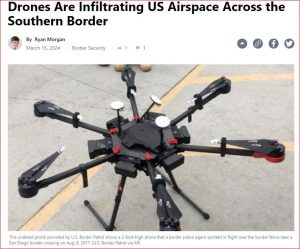
  • NORAD Commander Warns ‘Thousands’ of Drones Are Infiltrating US Airspace Across the Southern Border

    NORAD Commander Warns ‘Thousands’ of Drones Are Infiltrating US Airspace Across the Southern Border

    Read more:

    Thousands of unmanned drones may be transgressing U.S. airspace via the southern border every month, according to U.S. Air Force Gen. Gregory M. Guillot.
    Gen. Guillot—who assumed command of the North American Aerospace Defense Command (NORAD) and Northern Command (NORTHCOM) last month—was asked about the threat posed by unidentified drone aircraft operating on the Southern border during a Senate Armed Services Committee hearing on Thursday. As the leader of NORAD and NORTHCOM, Gen. Guillot is responsible for maintaining the security of airspace across the North American continent, and security cooperation between the United States, Canada, and Mexico.
    “The number of incursions was something that was alarming to me as I took command last month,” Gen. Guillot told Senators on Thursday. “I don’t know the actual number. I don’t think anybody does. But it’s in the thousands.”
    Citing conversations he’d had with U.S. Customs and Border Protection (CBP) officials, Gen. Guillot estimated that unmanned aircraft systems (UAS)—colloquially known as drones—transgress the U.S. southern border at least a thousand times a month.